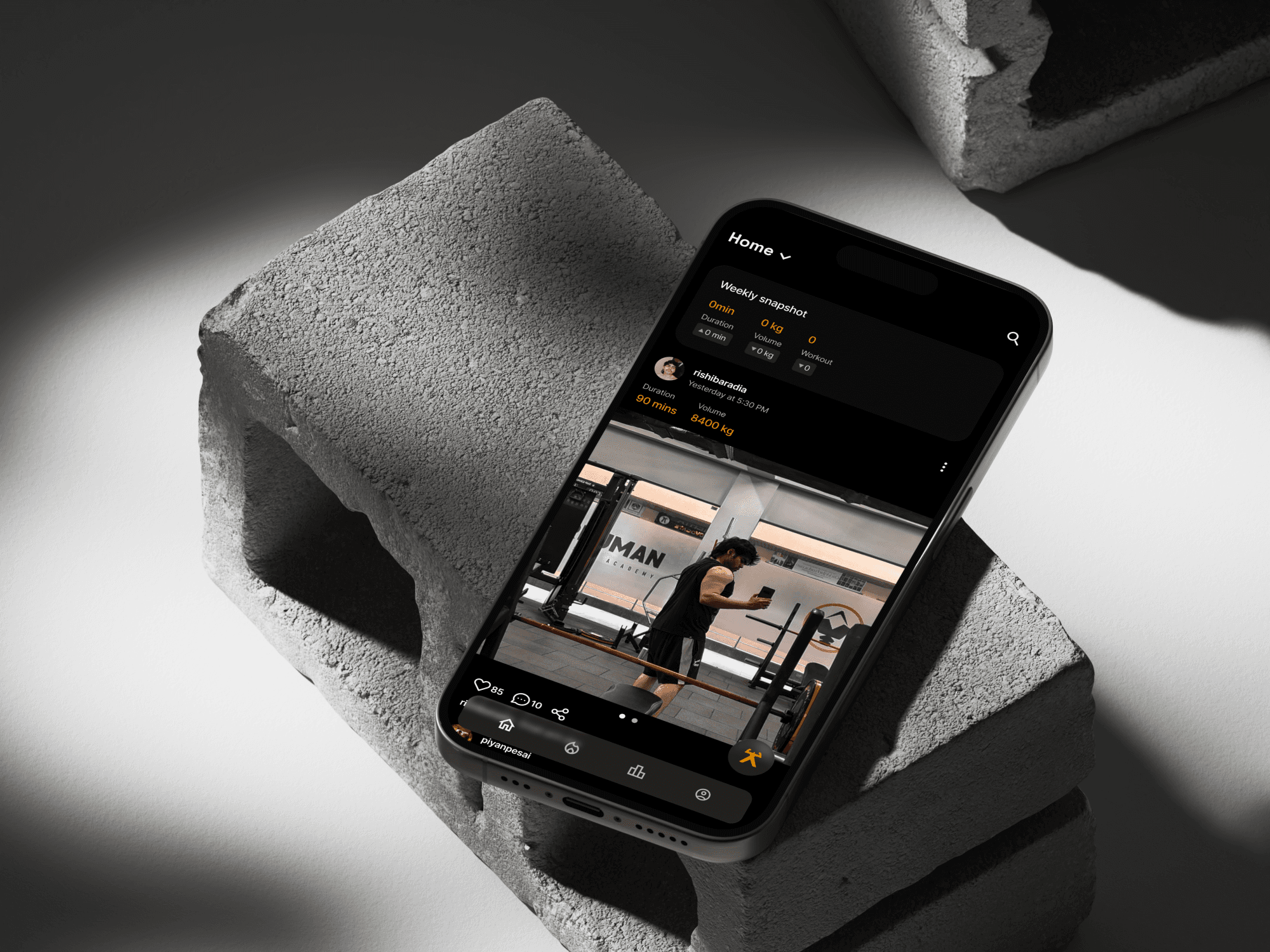
CHAD

Chad turns gym data into clear decisions, eliminating guesswork through explainable guidance. Built for intermediate lifters who are consistent, but confused about whether what they're doing is actually working.

role

Ux, Product, Brand design

client

Personal

year

'26

timeframe

2 Months

CHAD

Chad turns gym data into clear decisions, eliminating guesswork through explainable guidance. Built for intermediate lifters who are consistent, but confused about whether what they're doing is actually working.

role

Ux, Product, Brand design

client

Personal

year

'26

timeframe

2 Months

CHAD

Chad turns gym data into clear decisions, eliminating guesswork through explainable guidance. Built for intermediate lifters who are consistent, but confused about whether what they're doing is actually working.

role

Ux, Product, Brand design

client

Personal

year

'26

timeframe

2 Months

CHAD

Chad turns gym data into clear decisions, eliminating guesswork through explainable guidance. Built for intermediate lifters who are consistent, but confused about whether what they're doing is actually working.

role

Ux, Product, Brand design

client

Personal

year

'26

timeframe

2 Months

About

Context

Intermediate gym-goers are one of the most underserved segments in fitness tech. They're consistent, data-literate, and motivated — yet every major workout app treats them the same as beginners. They track everything and understand almost nothing about what it means. The market has data. It doesn't have interpretation.

Problem Statement

How might we design a workout tracking system that turns raw gym data into clear, actionable decisions, eliminating guesswork through intelligent, explainable guidance?

My Role

Solo designer — end-to-end. UX research · Product design · Brand identity · Design system · Hi-fi prototype

Outcome

Grounded in a 47-study systematic literature review + primary user research

Presented and defended before jury at UID — received distinction-level feedback

Brand identity — logotype, logomark, voice & tone guidelines

Complete design system: color tokens, typography scale, component library

Fully designed hi-fi prototype across 14+ screens — home, workout, progress, recovery, AI chat, onboarding

( 00-01 )

THE PROBLEM

The market has data. It doesn't have meaning.

The market has data. It doesn't have meaning.

My first problem statement was predictable: intermediate gym-goers lack effective ways to track and analyze. It implied the solution was better tracking. I was wrong about the diagnosis. People weren't failing to track, they were tracking obsessively and still walking out confused. The fitness app market isn't failing for lack of features. It's failing for lack of meaning.

The design question — written before any research began

The design question — written before any research began

How do you design a workout tracker that helps users understand their progress — not just collect it? This question drove every research method and design decision.

How do you design a workout tracker that helps users understand their progress — not just collect it? This question drove every research method and design decision.

( 00-02 )

THE RESEARCH

Two phases.

One signal, everywhere.

Secondary research first — six peer-reviewed studies on motivation theory, automation trust, and AI explainability. Primary research second — semi-structured interviews with beginner and intermediate gym-goers. I went in with hypotheses. I came out with behavioral patterns I hadn't anticipated.

LIT REVIEW · F01

Automation without explanation destroys trust

Wiese et al. (2018): users abandoned wearables not for inaccurate data — but because the system felt controlling. "Nagging." "Judging." The data wasn't the problem; the relationship was.

Explainability is behavioral necessity.

LIT REVIEW · F02

Progress drives consistency — motivation doesn't

Teixeira et al. (2012): motivation is the output of visible improvement, not the input. Users who can see progress sustain effort. Those who can't — regardless of intent — disengage.

Design for visibility, not motivation hacks.

PRIMARY · P01

Plateaus are universally misread as failure

Every participant interpreted stalled progress as ineffective training — not physiological norm. Result: panic, impulsive changes, overtraining. Nobody told them what a plateau means. That's a design problem.

Contextual reassurance is a core feature.

Two phases.

One signal, everywhere.

Secondary research first — six peer-reviewed studies on motivation theory, automation trust, and AI explainability. Primary research second — semi-structured interviews with beginner and intermediate gym-goers. I went in with hypotheses. I came out with behavioral patterns I hadn't anticipated.

LIT REVIEW · F01

Automation without explanation destroys trust

Wiese et al. (2018): users abandoned wearables not for inaccurate data — but because the system felt controlling. "Nagging." "Judging." The data wasn't the problem; the relationship was.

Explainability is behavioral necessity.

LIT REVIEW · F02

Progress drives consistency — motivation doesn't

Teixeira et al. (2012): motivation is the output of visible improvement, not the input. Users who can see progress sustain effort. Those who can't — regardless of intent — disengage.

Design for visibility, not motivation hacks.

PRIMARY · P01

Plateaus are universally misread as failure

Every participant interpreted stalled progress as ineffective training — not physiological norm. Result: panic, impulsive changes, overtraining. Nobody told them what a plateau means. That's a design problem.

Contextual reassurance is a core feature.

WHERE THE GAP LIES

CAPABILITY
CHAD
HEVY
LYFTA
STRONG
FITBOD
Workout logging
Plateau explanation
Explainable AI guidance
Partial
Between-set optimized UX

( 00-03 )

THE DESIGN

Chad is not a fitness logger.
It's a decision support system.

Chad is not a fitness logger.
It's a decision support system.

Recovery is context, not a metric

Every training decision happens in the context of how recovered you are. If that's missing from the interface, every recommendation is working with half the picture.

Explainability over automation

Every recommendation surfaces its reasoning. Trust is built through explanation, not through smart-seeming outputs that appear from nowhere.

Clarity over comprehensiveness

Show the right data at the right moment. Confidence, not completeness.

Recovery is context, not a metric

Every training decision happens in the context of how recovered you are. If that's missing from the interface, every recommendation is working with half the picture.

Explainability over automation

Every recommendation surfaces its reasoning. Trust is built through explanation, not through smart-seeming outputs that appear from nowhere.

Clarity over comprehensiveness

Show the right data at the right moment. Confidence, not completeness.

Key decisions — with the reasoning behind each

DECISION 01
PRODUCT FRAMING

Reframing "tracker" as "decision support system"

This changed the hierarchy of every screen. A tracker prioritizes data density. A decision support system prioritizes what matters right now. Every screen — home, progress, AI chat — is downstream of this single reframe.

Driven by: users who collected data but never made decisions from it.

DECISION 02
PLATEAU COPY

Writing plateau notices as reassurance, not data

The plateau card isn't a metric. It's a sentence designed to stop a destructive decision. "Your strength has stabilized. This is a normal phase." Written to land emotionally before informationally — because the emotional response (panic — bad decision) was the actual problem.

Driven by: every interviewee misread a plateau as failure.

DECISION 03
WHAT WAS CUT

Removed: direct social comparison

Early ideation included the ability to compare progress against other users. It was cut — not because nobody asked for it, but because it actively worked against the product's core purpose. Users who compared themselves to others didn't get motivated. They got anxious. Confidence in their own progress eroded the moment someone else's numbers entered the picture. Chad is built to make your data legible to you. Introducing external benchmarks undermines exactly that.

Driven by: comparison was found to damage user confidence — the opposite of what Chad is designed to build.

DECISION 01
PRODUCT FRAMING

Reframing "tracker" as "decision support system"

This changed the hierarchy of every screen. A tracker prioritizes data density. A decision support system prioritizes what matters right now. Every screen — home, progress, AI chat — is downstream of this single reframe.

Driven by: users who collected data but never made decisions from it.

DECISION 02
PLATEAU COPY

Writing plateau notices as reassurance, not data

The plateau card isn't a metric. It's a sentence designed to stop a destructive decision. "Your strength has stabilized. This is a normal phase." Written to land emotionally before informationally — because the emotional response (panic — bad decision) was the actual problem.

Driven by: every interviewee misread a plateau as failure.

DECISION 03
WHAT WAS CUT

Removed: direct social comparison

Early ideation included the ability to compare progress against other users. It was cut — not because nobody asked for it, but because it actively worked against the product's core purpose. Users who compared themselves to others didn't get motivated. They got anxious. Confidence in their own progress eroded the moment someone else's numbers entered the picture. Chad is built to make your data legible to you. Introducing external benchmarks undermines exactly that.

Driven by: comparison was found to damage user confidence — the opposite of what Chad is designed to build.

The product — screen by screen

Screen 01 · Home

The home screen is a launch pad, not a lobby.

Most fitness apps open on a dashboard, metrics, social feed, streaks. Chad opens on your splits. The user's primary job when they open the app is to start a workout. So that's exactly what they see first: their routines, ready to go, one tap away. This isn't a small UI decision, it's a statement about what the app thinks matters. Pre-built splits mean zero setup friction at the gym door. The amber Start button is the loudest visual element on screen, on purpose. Nothing competes with it. The "Start Workout" CTA at the bottom persists as a global escape hatch, for users who want to go rogue and log without a split. The screen accommodates both the planner and the spontaneous without compromise.

Screen 01 · Home

The home screen is a launch pad, not a lobby.

Most fitness apps open on a dashboard, metrics, social feed, streaks. Chad opens on your splits. The user's primary job when they open the app is to start a workout. So that's exactly what they see first: their routines, ready to go, one tap away. This isn't a small UI decision, it's a statement about what the app thinks matters. Pre-built splits mean zero setup friction at the gym door. The amber Start button is the loudest visual element on screen, on purpose. Nothing competes with it. The "Start Workout" CTA at the bottom persists as a global escape hatch, for users who want to go rogue and log without a split. The screen accommodates both the planner and the spontaneous without compromise.

Screen 02 · Progress

Screen 03 · Ai Chat

Screen 03 · Ai Chat

( 00-04 )

THE BRANDING

Going against fitness
conventions was deliberate.

Going against fitness
conventions was deliberate.

Most fitness apps lean on aggression, high contrast, urgency, imagery. Chad's user isn't someone who needs hyping up. They need a system that thinks clearly and explains itself. Precision over energy. Restraint over exuberance. The brand reflects the user it's designed for.

Asymmetric flexing figure. Intentionally imperfect — human imperfection as an honest brand signal.

( 00-05 )

THE REFLECTION

what this project taught me

what this project taught me

The most meaningful shift wasn't a design decision. It was a conceptual reframe, from data collection to data interpretation. Once I made that shift, every decision had a clear test: does this make data more interpretable, or less?

The recovery finding is the decision I'm most satisfied with. It sounds obvious in hindsight, of course recovery affects training, but no existing app was treating it as a first-class input. Surfacing it on the home screen wasn't a feature addition. It was an acknowledgment that half the picture had been missing all along.

The plateau notice taught me something about what UX copy actually does. No amount of better visualization would fix the problem. The fix was a sentence, written to land emotionally before informationally. That's not UX writing as polish. That's UX writing as product decision.

( 00-06 )

DISCOVER MORE

Want to check more?
Discover other projects.

Want to check more?
Discover other projects.

CLIENT PROOF
  • SHANTANU SINGH

    SENIOR COPYWRITER

    I’m impressed by how Rishi’s work translates a brand story into consumer-facing narrative that is seen, understood, and felt. Depend on Rishi to deliver high quality, imaginative, and intuitive design solutions.

  • YUNG WARIS

    STUDIO FOUNDER

    Rishi is a phenomenal designer with a fantastic eye for detail. He stayed completely on brief for our website while bringing his own creative touches that aligned with our brand. The whole process was seamless, the turnaround times were incredibly fast, and the final site looks amazing. Couldn't have asked for a smoother collaboration!

  • SIDDHARTH SUBIN

    STARTUP FOUNDER

    Rishi built weepstore.in from scratch. Clean, fast, and exactly on brand. He understood the vision without needing it explained twice and delivered something we’re genuinely proud to put our name on. Rare to find someone who just gets it

IN

09:53

IST
©2026
CLIENT PROOF
  • SHANTANU SINGH

    SENIOR COPYWRITER

    I’m impressed by how Rishi’s work translates a brand story into consumer-facing narrative that is seen, understood, and felt. Depend on Rishi to deliver high quality, imaginative, and intuitive design solutions.

  • YUNG WARIS

    STUDIO FOUNDER

    Rishi is a phenomenal designer with a fantastic eye for detail. He stayed completely on brief for our website while bringing his own creative touches that aligned with our brand. The whole process was seamless, the turnaround times were incredibly fast, and the final site looks amazing. Couldn't have asked for a smoother collaboration!

  • SIDDHARTH SUBIN

    STARTUP FOUNDER

    Rishi built weepstore.in from scratch. Clean, fast, and exactly on brand. He understood the vision without needing it explained twice and delivered something we’re genuinely proud to put our name on. Rare to find someone who just gets it

IN

09:53

IST
©2026
CLIENT PROOF
  • SHANTANU SINGH

    SENIOR COPYWRITER

    I’m impressed by how Rishi’s work translates a brand story into consumer-facing narrative that is seen, understood, and felt. Depend on Rishi to deliver high quality, imaginative, and intuitive design solutions.

  • YUNG WARIS

    STUDIO FOUNDER

    Rishi is a phenomenal designer with a fantastic eye for detail. He stayed completely on brief for our website while bringing his own creative touches that aligned with our brand. The whole process was seamless, the turnaround times were incredibly fast, and the final site looks amazing. Couldn't have asked for a smoother collaboration!

  • SIDDHARTH SUBIN

    STARTUP FOUNDER

    Rishi built weepstore.in from scratch. Clean, fast, and exactly on brand. He understood the vision without needing it explained twice and delivered something we’re genuinely proud to put our name on. Rare to find someone who just gets it

IN

09:53

IST
©2026